


The Retirement Transition Trap™
What Is the Retirement Transition Trap™ and Why Does It Matter?
The Retirement Transition Trap™ is the ten-year window around retirement, when your finances shift from saving to spending. See why it matters and how to plan for it.
Key Takeaways:
- The Retirement Transition Trap™ is a ten-year window. It covers the five years before retirement and the first five years after, when a household shifts from saving to spending down what it saved.
- The strategy that built your wealth isn’t built for spending it. Steady saving and riding out downturns work while you’re earning, but they strain once your portfolio has to pay you instead.
- Several risks peak at once in this window. A weak early market, rising withdrawals, and tax missteps are each manageable alone, but together they can do lasting damage to a portfolio.
Retirement is more than the day you stop working. It’s a financial handoff: after decades of earning a paycheck and building your investments, you start relying on what you saved to pay for everyday life.
ClientFirst Wealth, Legacy & Estate Planning calls the years right around that shift the Retirement Transition Trap™. The stakes are high: once long-term care costs are factored in, roughly 41% of U.S. households are projected to run short of money in retirement.¹ Much of that risk is concentrated in the handoff from saving to spending. Once your paycheck is about to stop and your portfolio has to start producing income, the usual rules change.
What Is the Retirement Transition Trap™?
The Retirement Transition Trap™ is a specific ten-year window: the five years before retirement and the first five years after. ClientFirst built the framework around this stretch because it’s where the handoff from saving to spending actually happens, and where small missteps are hardest to undo.
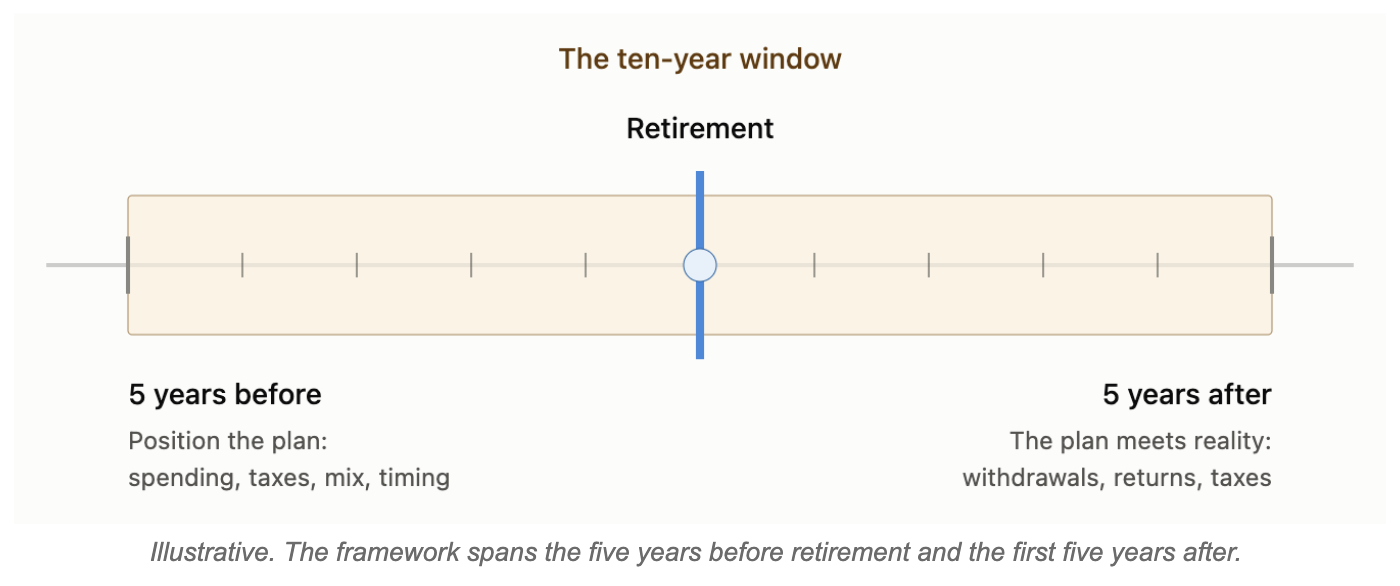
It starts before your last day on purpose. In those final five working years, choices about how your portfolio is positioned, what you expect to spend, which income sources you’ll turn on, how you’ll handle taxes, and even when you retire all shape how ready you are before the paycheck stops.
It runs five years past your retirement date because that’s when the plan stops being a projection. Assumptions turn into actual withdrawals, spending, market returns, and tax bills, and the plan gets tested under live conditions for the first time.
This isn’t just another name for a market crash or sequence-of-returns risk. It’s a broader way to understand the vulnerable handoff between building wealth and living on it. Decisions that were forgiving while you were still earning and contributing get harder to reverse once your assets fund your life. For a closer look at that stretch, see the five years before and after retirement.
Why the Accumulation Playbook Starts to Break Down at Retirement
For most of your working life, the playbook is straightforward, and it works: save consistently, max out workplace retirement accounts where it makes sense, stay invested, give the market time to bounce back from drops, and let your paycheck, not your portfolio, cover the bills. Retirement pulls several of those pillars out from under you at once:
- Contributions Flip to Withdrawals: While you’re working, your paycheck covers spending and new savings flow in. Retirement runs that in reverse: wages stop, and the portfolio starts sending money out, which changes how much every market move actually matters to you.
- Market Declines Are Harder to Wait Out: A working investor can keep contributing through a downturn and leave their invested money alone to recover. A retiree often has to sell during the decline to cover living costs, so waiting for the rebound may not be enough on its own.
- Tax Deferral Gives Way to Withdrawal Planning: Building wealth rewards putting money in and postponing taxes. Spending it down flips the question: which account funds this year’s spending, how much taxable income to recognize, and how today’s withdrawals affect your flexibility later.
- Growth Has to Share the Job With Income: While you’re saving, long-term growth can be the main goal because your paycheck pays the bills. In retirement, the portfolio has to deliver steady near-term cash flow and keep enough growth to outpace inflation over a long retirement.
The Risks That Make the Retirement Transition Trap™ Matter
Retirement doesn’t necessarily invent brand-new risks. What it does is change how exposed you are to risks you could shrug off while paychecks and contributions were still rolling in.
The bigger danger is overlap. A weak market, a larger-than-planned withdrawal, an unexpected expense, or a clumsy tax decision might each be survivable on its own. Together early in retirement, they can put far more pressure on a portfolio than any one of them alone.
Sequence-of-Returns Risk Can Turn an Early Loss Into a Lasting Problem
Your retirement outcome doesn’t hinge only on your average return. It also hinges on when the good and bad years arrive relative to your withdrawals.
If the market falls early in retirement while you’re also pulling money out for living expenses, you have to sell investments at depressed prices. Those sold-off dollars aren’t there to rebound when the market recovers so an early loss can leave a permanent dent.
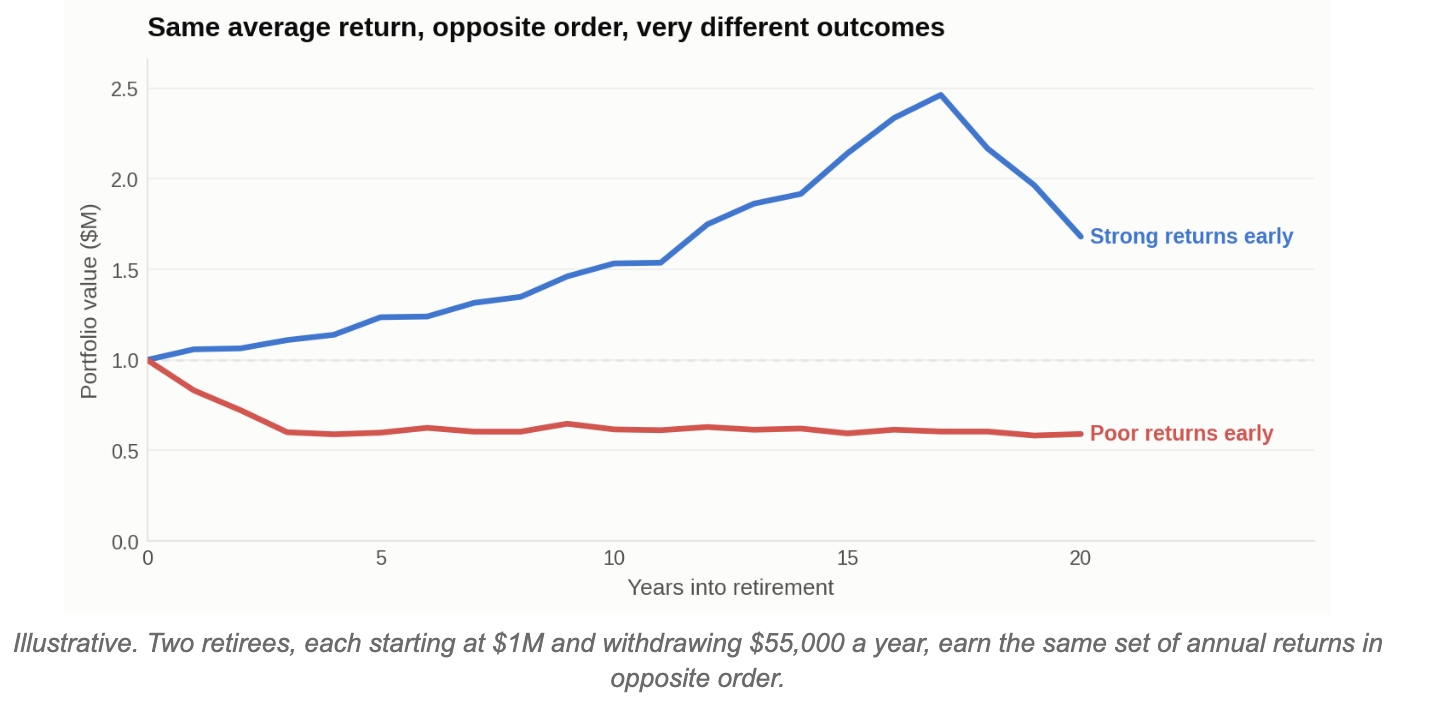
That’s what makes it different from the same downturn during your working years. While you're still earning, you can leave the portfolio alone or even buy more at lower prices. If you're drawing income from it, you may not have that luxury. And the timing is cruel: your portfolio is often at its peak right as it starts funding a withdrawal period that could last decades.
Other Pressures Can Compound an Early Retirement Setback
Sequence risk rarely shows up alone. A few other pressures tend to cluster in the same early years, and each one can deepen a setback that’s already underway.
Watch how these can stack on top of a weak early market:
- Early Retirement Spending: Travel, home projects, a new car, gifts to family, or just settling into a new lifestyle can push spending above plan in the first few years. Those higher withdrawals bite hardest if they land during a down market.
- Withdrawal Taxes: The account you pull from decides how much of a withdrawal you actually keep. Large taxable distributions can also nudge you into a higher bracket and, in some cases, raise future Medicare premiums.
- Income Timing: When you turn on Social Security, a pension, or other dependable income changes how hard your portfolio has to work during the transition years. Starting it later can ease the load, but it means leaning on the portfolio more in the meantime.
- Longevity and Inflation: Fixing near-term risk by dumping all your growth isn’t free. A retirement can run several decades, so the plan still has to protect your purchasing power years from now, not only cover this month’s expenses.
What a Retirement Plan Built for the Transition Needs to Do Differently
Planning for the Retirement Transition Trap™ means redesigning the plan for the spending years, not running your saving strategy on autopilot after the paycheck stops. A few shifts make the difference:
- Start with your actual spending needs, line up your dependable income sources, and calculate how much the portfolio must provide, instead of defaulting to a generic withdrawal percentage.
- Separate the money that funds near-term spending from the money invested for long-term growth, so a stock-market drop doesn’t dictate where every retirement paycheck comes from.
- Coordinate withdrawals across taxable, tax-deferred, Roth, and cash accounts with your whole income picture, rather than pulling from whatever’s easiest to reach.
- Account for the different clocks around retirement: Social Security, Medicare, future required distributions, and other income that shifts the portfolio’s job over time.
- Build flexibility into spending and withdrawals so the plan can bend when actual returns, expenses, taxes, or income differ from the assumptions.
The takeaway: preparing for the Retirement Transition Trap™ means deliberately rebuilding the plan for the spending years instead of letting an accumulation strategy coast once the paycheck ends. For specific moves, see three ways to avoid the Retirement Transition Trap™.
Retirement Transition Trap™ FAQs
1. What is the Retirement Transition Trap™?
It’s ClientFirst Wealth, Legacy & Estate Planning’s framework for the 10–year period beginning five years before retirement and extending five years into retirement. It’s the stretch when your finances shift from building wealth to living on it, and when several risks that were easy to absorb while you were working start to matter much more.
2. When does the Retirement Transition Trap™ begin and end?
It is a 10–year period beginning five years before retirement and extending five years into retirement. The early part positions the plan while you’re still earning; the later part tests it through real-world withdrawals, returns, and taxes.
3. Why is sequence-of-returns risk especially important around retirement?
Because your outcome depends on when returns happen, not just their average; if the market falls early while you’re withdrawing for living expenses, you sell at low prices, and those dollars miss the recovery. The same drop during your working years is far easier to absorb, since you’re not pulling income from the portfolio.
4. What happens if the stock market falls shortly after I retire?
An early decline paired with withdrawals can permanently shrink what’s left to recover, which is the core of sequence-of-returns risk. A plan built for the transition softens this by keeping near-term spending in safer assets, so you’re not forced to sell growth investments at the worst time.
5. Does preparing for the Retirement Transition Trap™ mean I should move my retirement portfolio into cash or bonds?
Not usually. Going all-cash trades one risk for another, since a retirement can last decades and still needs growth to keep up with inflation. The goal is balance: enough stable, accessible money for near-term spending, with enough growth to support a long retirement.
6. How far before retirement should I start preparing for the Retirement Transition Trap™?
About five years out is a reasonable starting point, which is why the framework begins there. Starting early gives you room to adjust your portfolio, spending plan, tax strategy, and income timing while you still have a paycheck, rather than reacting once withdrawals have already begun.
Get Help Planning Around the Retirement Transition Trap™
Getting to retirement takes more than hitting a target account balance and asking whether you can afford to retire. The harder part is turning what you saved into income while still managing market risk, taxes, spending, and a retirement that could last a long time.
ClientFirst Wealth, Legacy & Estate Planning focuses on exactly that handoff from accumulation to distribution. The team can help coordinate your retirement income, tax planning, investment decisions, and Social Security timing- the pieces that become more consequential during the Retirement Transition Trap™.
That work doesn’t stop at your retirement date. ClientFirst keeps reviewing the plan as projected spending, returns, taxes, and income become actual results, adjusting as needed. If you’d like help preparing for and moving through this window, schedule a complimentary consultation with ClientFirst Wealth, Legacy & Estate Planning.
Resources:
This presentation is not an offer or a solicitation to buy or sell securities. The information contained in this presentation has been compiled from third-party sources and is believed to be reliable; however, its accuracy is not guaranteed and should not be relied upon in any way whatsoever. This presentation may not be construed as investment, tax or legal advice and does not give investment recommendations. Any opinion included in this report constitutes our judgment as of the date of this report and is subject to change without notice.
Additional information, including management fees and expenses, is provided on our Form ADV Part 2 available upon request or at the SEC’s Investment Adviser Public Disclosure website, www.adviserinfo.sec.gov. Past performance is not indicative of future results.
The views expressed are those of the author as of the date noted, are subject to change based on market and other various conditions. Material discussed is meant to provide general information and it is not to be construed as specific investment, tax or legal advice. Keep in mind that current and historical facts may not be indicative of future results. The information contained in our presentations has been compiled from third party sources and is believed to be reliable; however, accuracy is not guaranteed.
Related
The Retirement Transition Trap™
How Should Your Investments Change as Retirement Approaches?
8 min read
The Retirement Transition Trap™
What Changes Financially When You Retire?
8 min read
The Retirement Transition Trap™
The Five Years Before and After Retirement: Your Complete Guide to Preparing for the Transition
10 min read
Questions about your own situation?
Step one is a 15-minute discovery phone call about your situation: your concerns, your goals, and whether our firm is a good fit. No cost, no obligation, and no requirement to transfer assets.